Monday, April 7, 2014
Donna Leon "By Its Cover"
They say you can't, but with Donna Leon's Commissario Brunetti series that landed on its feet almost fully formed running to twenty-three titles anyone who's been along for most of the ride can take a glance at the book and have a pretty fair idea of what they'll be getting.
The elements will, of course, vary from title to title. The amount of time Brunetti gets to spend at home and when he manages to get there will affect how much of his family the reader sees in each successive title. The actual case he's dealing with may or may not present opportunities for the wonderful and highly efficient Signorina Elettra to do her computer-based thing.
Brunetti's boss, the entirely loathsome Vice-Questore Giuseppe Patta, will appear in his office just before lunch and depart not that long afterwards, and how far his nose sticks into Brunetti's case will depend on the case's effect on the issues that matter to him.
Apart from Signorina Elettra most of the cast have been in place since the first title in a series that landed on its feet almost fully formed from the start of Death at La Fenice. You know, more or less, what you're going to get. It's just a question of detail and delivering an outcome.
This time around it's an afternoon phone call from the director of Biblioteca Merula, a prestigious library with an extensive holding of rare books. A number of titles have had pages cut out, maps and illustrations rather than pages of text, and others have gone missing.
As far as library director Dottoressa Patrizia Fabbiani is concerned there's an obvious suspect. American academic Joseph Nickerson, from the University of Kansas, has been using the library for research into medieval Mediterranean maritime trade but has suddenly vanished after daily visits over a solid three week period. Books he has requested are gone, others are damaged. There's your man. Q.E.D.
He's definitely a suspect, particularly after his passport turns out to be a fake and a check with the University of Kansas reveals they have no one by that name on the payroll.
But he's not the only regular visitor who passes under the gaze of library guard Piero Sartor.
Another regular reader is the former priest the library staff has nicknamed Tertullian since his regular reading matter is mainly drawn from the works of this prolific early Christian polemicist against heresy. According to the Wikipedia Tertullian has been called the father of Latin Christianity and the founder of Western theology.
According to Brunetti, on the other hand, he's dry as dust and the fact that anyone, ex-priest or not, would spend three years reading his voluminous output piques his interest. The latter day Tertullian also seems to have vanished and when he is found brutally murdered, Brunetti finds himself investigating something more serious than theft.
The Patta angle this time around kicks in when he learns that several of the vandalised or missing volumes were donated to the library by Contessa Elisabetta Morosini-Albani, the wealthy widow whose late husband was the head of a long-established Venetian family. As a total philistine, the theft and vandalism barely register on Patta's radar. The possibility that the Contessa's nose might be put out of joint is entirely another matter and Brunetti is cleared to investigate a matter that might otherwise have been pushed to one side and pinned on the obvious suspect.
Interestingly, when Brunetti interviews the Contessa his wife's aristocratic connections come into play as Brunetti quietly goes about piecing the ins and outs of the trade in purloined vintage editions together.
By Its Cover seems to have been prompted by a wave of theft and vandalism in libraries, museums and churches, and particularly by the systematic looting of thousands of rare books from Girolamini Library in Naples unearthed in 2012. That was the work of the library's director, and here, as Brunetti patiently peels away the layers of things that aren't quite what they seem Leon gets the chance to vent through her characters.
Theft and vandalism in the world of rare books aren't the only things to attract her wrath. There's a particularly well crafted incident involving a massive cruise liner Brunetti and his offsider encounter in the course of their perambulations (or the maritime equivalent thereof) and the presence of crowds of tourists as spring starts to kick in are a perennial target as well.
When you're looking at a series that has been running this long you're always likely to suspect a tendency to phone it in, and you may well think that's operating here. There's not much that could be described as a new development, and not much room for Signorina Elettra to do her thing, but that's largely a function of the subject under investigation. You can use the internet to check things like prices of rare books, but that's about as far as it goes.
But if the author is delivering the latest episode telephonically I'd suggest there'll be a tendency on the part of the reader to put things aside. By Its Cover's blend of intrigue, theft, blackmail and murder kept me turning the pages until I got to the end and left me looking for more after a characteristically abrupt end.
The Golden Egg ended with Brunetti setting out for a brooding walk along a wind and rain swept Lido, and By Its Cover comes to a full stop because, really, once Brunetti has pulled out his phone and dialled the number of the Questura and requested the warrant there really isn't anything more that needs to be said.
Friday, March 21, 2014
Peter Corris "Silent Kill"
A silent kill, Cliff Hardy ’s friendly Intelligence Agency acquaintance informs him, is one of those rare instances where intelligence chiefs sanction the removal, leaving no body, witnesses or clues, of people whose continued existence constituted a serious threat.
To national security? Hardy asks.
Yes, Josh Carey responds, but more often to the organisation itself.
That exchange takes place at the beginning of Chapter 28, but it’s fairly obvious from very early in the piece that the ex-firebrand student agitator turned populist whistleblower Rory O’Hara would be a prime candidate for a silent kill.
Given that description, O’Hara obviously has enemies, and he still hasn’t recovered from a hit-and-run incident that was almost certainly not an accident when Hardy’s ex-commando, stuntman and actor Jack Buchanan approaches him with a job offer.
Buchanan has sunk a lot of money into O’Hara’s forthcoming speaking tour, which is going to attract very big, high-paying audiences and will be followed by a documentary, high-profile television interviews and a book deal.
The tour is also going to publicise O’Hara’s new political party, which looks like attracting significant defectors from both major parties and The Greens. That means you’ve got all the major parties as potential enemies, along with the people behind a massive development project in the western suburbs that O’Hara had exposed as shonky and corrupt.
That adds a fundamentalist Christian church, a major trade union, a superannuation fund and … an outlaw bikie gang to the enemies list, along with corrupt local councillors and a state government minister.
The fear, as far as Buchanan is concerned, is that there’s a traitor lurking in O’Hara’s entourage. He wants Hardy to act as a combination of bodyguard, security consultant and traitor detector.
The first stop on the speaking tour is Wollongong, which is also where it ends after O’Hara’s girlfriend is abducted and the abductor is murdered. So much for the security consultant gig.
The murder victim’s wealthy brother, however, comes to the rescue, hiring Hardy to investigate the murder, and providing almost unlimited financial resources to fund the investigation.
Hardy uncovers assorted hidden agendas among O'Hara's entourage, powerful political, intelligence and commercial concerns in an investigation that winds its way through Sydney, Darwin and Canberra.
Along the way, he picks up the clues that lead him to the killer with the assistance of the resourceful Dave Burns, a Tiwi Islander (the only indigenous person with a PIA licence, as far as I knew) and an uneasy alliance with O’Hara’s former personal assistant, who has her own scores to settle as far as the killer is concerned.
The heritage township of Gundaroo delivers a terrible secret, and the pursuit leads to a Russian cafe in Manly where his quarry, who has turned out to be a rogue intelligence agent with psychopathic tendencies plays highly competitive chess for money.
Hardy’s private life remains as messy as ever as he becomes involved with the attractive personal assistant, the former swimmer and motivational speaker Penelope Milton-Smith, who has gone back to using her maiden name (Marinos) while set tries to avoid the killer.
That comes after the departure of his live apart girlfriend to greener pastures in Los Angeles, and while the new interests have been known to stick around from one book to the next, Penelope is damaged goods and follows professional advice to move on.
And that, as we carefully step around spoiler territory, is the gist of Corris’ thirty-ninth Cliff Hardy yarn. Given the longevity of the series, you’d expect things to verge on the formulaic, but even where it does Corris manages to avoid ‘phoning it in.’
It’s a remarkable achievement by one of the icons of Australian crime fiction, delivered with the regulation hard-boiled observations at a crisp, page-turning clip. Corris’ eyesight is failing, but hopefully we’ll get to Hardy #40.
Labels:
Canberra,
Cliff Hardy,
Crime,
Darwin,
Peter Corris,
Sydney
Wednesday, March 19, 2014
David Hunt "Girt: The Unauthorised History of Australia"
Spend any time at all contemplating the notion that there’s a “Real Australia” lurking out there somewhere or pondering the possibility of an Australian identity, and you’ll more than likely come to recognise that we’re rather good at denialism.
Now, The Argumentative Reader might contend denialism is a little bit strong, and in the face of that sort of criticism you might be tempted to water things down a little. Substitute a firm but polite we’d rather not talk about that, thank you very much, perhaps.
That’s one of the things I tend to find interesting when the subject of the History curriculum rears its head from time to time. There seems to be an unwillingness to consider certain topics, and if anyone’s scratching their heads and wondering why students find Australian history boring, you might start by considering the possibility that we’ve chopped out most of the interesting bits because there’s stuff in there that we’d rather not talk about.
My primary school exposure to Australian history came, of course, in an entirely different era, and one in which the possibility of someone producing something like the title under discussion here wasn’t totally non-existent. Just mostly, like about 99.999999%.
Author David Hunt is, among other things a comedy writer, and takes great delight in lampooning Australia’s earliest years, taking the narrative as far as the end of the Macquarie era. That leaves a fair bit of territory to explore, and hopes he has the inclination to continue.
He covers all of what one might term the usual suspects, from the Indigenous destruction of the continent’s ancient megafauna by fire, through Makassan fisherman trading in Arnhem Land to seventeenth-century Dutch explorers sailing along the Western Australian coastline busily nailing plates to trees.
In 1606, Willem Janszoon landed near present-day Weipa and named the land he’d discovered Nova Guinea, as distinct from New Guinea, which he labelled Os Papua, part of which he called Nieu Zelandt. Hunt is rather good at coming up with that sort of detail and displays a remarkable ability to dig around and come up with something that’s strange enough to be true, and cites Mark Twain’s take on Australian history:
It does not read like history, but like the most beautiful lies … but they are all true, they all happened.
And, of course, when he gets to the English contribution to our nation’s history and national identity things get really interesting. We get the connections between Captain Cook of the Endeavour, and Star Trek's Captain Kirk of the star ship Enterprise and learn that the first and last space shuttles, took their names from the two vessels.
As far as Cook is concerned, the Captain Cook Monument at Botany Bay has him setting foot a day early (on 28 April 1770 rather than on the afternoon of the 29th). When he set out on his first voyage Cook had never crossed the equator. By way of contrast the ship’s goat had circumnavigated the globe the previous year and received a silver collar engraved with a poem by Dr Samuel Johnson after its second circuit .
And then we get to Joseph Banks, a dedicated pants man, who’d planned to smuggle his mistress onto Cook’s second voyage disguised as a Mr Burnett. One could cite further examples of eccentric behaviour from a botanist who was dismissive of Portuguese gardening techniques and displayed an inclination towards fishing trips with two or three Ladies of pleasure accompanied by his mate the Earl of Sandwich, who happened to be First Lord of the Admiralty and would go on to have his name associated with the dietary staple of the Australian school lunch.
There are all sorts of other examples that could be cited, and we’re definitely getting close to spoiler territory, but one can’t help pointing out that Mary Reibey, who is portrayed on the $20 note, was a cross-dressing convict entrepreneur who built up an extensive pastoral, hotel, shipping and sealing empire and leased her house to Governor Macquarie so it could be the first branch of the Bank of New South Wales.
Macquarie, we learn, is hardly the shimming light he was presented to primary school students of my generation, and William Francis copped a seven year sentence for stealing A Summary Account of the Flourishing State of the Island of Tobago.
And, trust me, there’s plenty more detail to revel in.
One awaits the sequel with considerable interest.
Martin Cruz Smith "Tatiana: An Arkady Renko Novel"
If there wasn’t a specific link on the official Martin Cruz Smith website I probably wouldn’t be referring to the revelation that one of my favourite authors has had Parkinson’s Disease and the diagnosis dates back to 1995.
Under the circumstances, one can see why he kept it hidden from the reading public, but it was also a closely guarded secret as far as his publisher and editors were concerned. You would tend to assume, given the medical condition, that the writing might suffer, but in the period since the diagnosis he’s produced the Arkady Renko titles Havana Bay, Wolves Eat Dogs, Stalin's Ghost and Three Stations, all of which were quite sublime.
And, with Tatiana, he’s done it again, confirming a long-held belief that a new Martin Cruz Smith Arkady Renko novel needs to be approached as soon as I can get my hands on it. Better still, from my reading of the photographs here, there’s more on the way.
It’s not as if there’s going to be a lack of material to work with. While Arkady Renko has survived the transition from the old Soviet Union to Vladimir Putin’s New Russia, the country’s oligarchy is as obsessed with maintaining secrecy and enforcing its wishes through whatever means it deems necessary as any of its predecessors have been.
There are disturbingly familiar events at the beginning of Tatiana after reporter Tatiana Petrovna is alleged to have thrown herself from the sixth-floor window of the Moscow apartment she was trying to save from demolition by corrupt developers who want to convert the area into a shopping complex.
Her death coincides with a power vacuum at the top of the criminal food chain after the execution-style murder of mob billionaire Grisha Grigorenko, a member of the Moscow Chamber of Commerce and patron of charities and the arts whose status stems from his interests in drugs, prostitution and stolen weaponry. While Grigorenko is buried with the trappings associated with a feudal lord, his death paves the way for a war of succession involving his son and heir apparent, and other Mafiosi with criminal empires of their own.
Given the tendency for mobster funerals to attract persons of interest, Renko and his offsider attend Grigorenko’s funeral, where Arkady is sidetracked by a protest about Tatiana’s death. Her record of exposing corruption and cover-ups in government circles means there were any number of people who’d want to see her dead and the official verdict of suicide seems a little less than credible. There is a witness who heard her screaming as she fell.
What caught Arkady’s attention was that a neighbour had heard her scream. Suicide usually took concentration. People who committed suicide counted pills, stared in fascination at their pooling blood, took the high dive in silence. They rarely screamed.
Renko finds himself on the receiving end of some police brutality at the protest, but is persuaded to take a closer look at the investigation into Tatiana's death. The Cynical Reader might find this a little hard to accept, but a combination of Renko’s background and the fact that he’s carrying a bullet in his skull after a near-death experience in a past investigation means he’s not particularly concerned about the consequences of a little inquisitiveness.
Add Arkady's neighbour and interim lover Anya Rudenko’s involvement in the demonstration, the cemetery’s refusal to inter Tatiana’s body which couldn't be located at any of the city's morgues and then was allegedly found and cremated before any investigation could begin and you’ve got a combination of circumstances that are almost guaranteed to pique a predilection towards inquisitiveness.
Then there’s the notebook and the tapes.
As Arkady starts sniffing around, assisted by his loyal alcoholic comrade, Sgt. Victor Orlov, the investigation leads from Moscow to the Baltic port of Kaliningrad, a geopolitical oddity populated by hundreds of thousands of ethnic Russians.
The city was originally Konigsberg, part of eastern Prussia wedged between Poland and Lithuania taken by the Red Army in the dying days of World War II and held by the Soviet regime as a closed strategic region. Stalin forced the entire population to relocate and repopulated the city with Russians, but no one admits they are from Kaliningrad.
They call themselves Koenigs instead.
In the post-Soviet era Kaliningrad remains an important port, is the centre of the amber industry, boasts the highest crime rate in Russia and, interestingly, happened to be Grisha Grigorenko’s power base.
Kaliningrad also gives us another body, that of cycling fanatic interpreter Joseph Bonnafos, whose death on a deserted Kaliningrad beach at the hands of a psychopathic butcher who stalks the beach in a van with a smiling plastic pig on its roof is described in the Prologue. He’s the author of the mysterious notebook, kept in a cryptic form of shorthand by a linguist who loved word games.
And the dead interpreter’s notebook seems to link the other two deaths, with possible details of all sorts of dodgy dealings in the interactions between the government, criminal gangs and foreign powers. All that’s needed is someone who can crack the translator's personal and seemingly indecipherable code.
In the end, of course, the code is cracked and the notebook delivers details of a clandestine meeting attended by Moscow’s leading criminals along with a series of revelations about corruption and greed.
And the tapes.
Having entered Tatiana’s abandoned apartment, Renko finds the archive of tapes that hold her spoken accounts of horrific crimes. Her accounts clash with the Kremlin's official versions of, among other events, the sinking of the Kursk nuclear submarine in 2000, the terrorist takeover of a Moscow theatre in 2002, the Beslan school massacre in 2004 and the Moscow metro bombing of 2010.
Many of those events were covered by Anna Politkovskaya, the Russian journalist and human rights activist gunned down in the elevator of her Moscow apartment building in 2006. She provides the obvious template for Tatiana. Since her death was obvious payback for her aggressive reporting of events on the ground in Chechnya and exposés of corruption it was never going to be investigated too vigorously, and Moscow prosecutors ended up assigning blame to a former policeman sentenced in December 2012.
Anna Politkovskaya didn’t have Renko on the case.
Here, once he has access to the tapes, as he listens to Tatiana's recorded notes about scandals at home and abroad (Both sides have the same weapons … because our Soviet soldiers have traded their weapons for vodka. Here in Afghanistan, vodka is the great equalizer) the details are enough to have the reader lining up beside Renko in the quest for truth and justice without descending into overworked doom and gloom.
There are other difficulties that cast themselves into the path as Renko sets out to get to the bottom of things, and the chief among them is his semi-official foster son, Zhenya. The moody seventeen-year-old chess prodigy is blackmailing Renko to give him permission to enlist in the Army. In return for that permission, Zhenya will have a go at cracking the code, assisted by another chess prodigy, an attractive young woman whose grandfather paints portraits of Stalin. While they're hunkered down with the notebook in Arkady's Moscow apartment, Renko has plenty on his hands as he continues to pursue his investigations in Kaliningrad.
And that is where we start to get rather close to spoiler territory. Things work out in the end, and work out a deal better than the reader has any right to expect. But while Tatiana ends on a comparatively high note the reader just knows there’ll be another case, or another issue with Zhenya that’ll have Renko out in pursuit of a more civilised Russia.
The brutal criminal billionaires at the top of the pecking order aren’t going away anytime soon, bureaucratic incompetence that has become endemic is never going to disappear, the lines between organised crime and big business are going to stay blurred, investigative journalism will still put lives at risk and a reluctance to investigate matters that might involve the rich and powerful will continue in official circles.
On that basis, it’s just a matter of waiting to see what attracts Renko’s attention next time around.
I, for one, hope it won’t be a long wait.
Wednesday, November 13, 2013
Jonathan Coe "Expo 58"
There are, in hindsight, some things that are strange enough to be true. It may come as a surprise to learn that thirty years before Expo 88 transformed Brisbane from oversized country town to notionally cosmopolitan city something similar was going on in the 1958 World's Fair in Brussels.
Younger readers will probably find some of the world Coe portrays here quaint, but having lived through the Anglophile Australian suburbia of the fifties a few things here that cut pretty close to the quick.
The plot line is fairly straightforward exercise in innocent abroad set against a Cold War backdrop that will probably appear surreal to those who weren’t in the vicinity at the time.
On the eve of the 11th World’s Fair in Belgium, the first to be held since the Second World War, where the intention is to show off international achievements in arts, science and technology, and develop a genuine unity of mankind, the heads of the British Civil Service are looking for the best way to demonstrate the essence of Britishness.
There’s a rather accurate skewering of the official mindset in an introductory scene where one of the head honchos in Whitehall suggests a military tattoo, and it looks like a history of the water closet will be one of the centrepieces of the British pavilion.
The actual centrepiece, however, is the imitation English pub called The Britannia, complete with a landlord who is inclined to indulge himself in the merchandise. It is, however, a Government operation, and will need a government man to supervise things, which brings us to our protagonist, Thomas Foley, thirty-two year old copywriter for the Central Office of Information.
You and I might think a man whose main gig is writing pamphlets advising people how to cross the road safely isn’t likely to be the man for this particular task, but there are two factors that seemingly make him eminently suitable for the position. Foley’s father was a publican, and his mother is Belgian. Game, set and total match for the position.
Foley comes across as a thoroughly decent chap, handsome but unaware of it, aware the opportunity he’s been presented with should be good for his career, but not quite enthused by having to leave his wife Sylvia and infant daughter Gill behind in suburban Tooting.
Part of that unease is due to the fact that his intrusive next door neighbour Norman Sparks seems keen to be sniffing around the missus in his absence.
Prior to departure Foley is approached and assessed by Mr Wayne and Mr Radford, a pair of intelligence agents who make a habit of popping out of the woodwork from time to time as the plot develops. They’re a sort of cross-talking music hall Greek chorus, dropping by with news and observations every time the espionage-driven side of the plot takes a new turn.
Not that the spy side of the deal is immediately obvious. Foley arrives in Brussels to be met by the alluring Anneke, the pretty young Expo hostess who seems to be laid on as potential bed bait. He’s also smitten by the Expo site itself, by the gigantic structure called the Atomium, the 100-metre representation of an iron atom that supposedly symbolises the connectedness of nations and by the futuristic architecture scattered across the landscape.
At that point, it’s obvious that Foley’s suburban British existence is about to be shattered by a combination of erotic opportunity and modernity, and it’s difficult to criticise him if he’s inclined to take advantage of the opportunity. Once he’s caught up in the day to day glamour of Expo he’s going to become alienated from the realities of suburban existence, The intermittent correspondence between home and semi-innocent abroad grows increasingly distant as he begins to suspect his wife is having it off with the neighbour.
The letters do, however, contain a degree of humour as he points out some of the little absurdities he observes. The platinum blonde barmaid who fortuitously turns up at The Britannia rejoices in the name of Shirley Knott, but turns out to be something other than what she appears to be. There’s a visit from the Fifth European Congress on Fluoridisation and Prevention of Dental Decay where a delegate breaks a tooth on the crust of a pork pie and a delegate from the World Congress on the Prevention of Accidents falls down the stairs.
What doesn’t get mentioned is Foley’s increasing attraction to Anneke, and the imbroglio that follows the disappearance of Foley’s roommate, who disappears after the star in Britain's scientific crown, the ZETA nuclear fusion programme, turns out to be a dud.
His roommate in Cabin 419 at Motel Expo Wemmel, Tony Buttress, is on site in connection with the ZETA machine, and goes when it goes, which presents a problem. He’s been seeing quite a bit of American Emily Parker, an out of work actress from Wisconsin who has landed a gig in the American pavilion to demonstrating the virtues of the vacuum cleaner and similar labour saving devices.
With Buttress gone, the jovial Russian handsome; almost dangerously so pseudo-journalist Andrey Chersky who had been befriending Foley in a supposed attempt to improve his English language magazine (predictably, Sputnik) starts sniffing around the apparently impressionable Emily.
The complication in that department comes wit the news that Emily’s alleged father is a leading American nuclear physicist, and there’ll be hell to pay if she defects. On that basis, Foley is persuaded to turn his attentions directly towards the American.
A weekend visit home delivers what appears to be confirmation of his wife’s affair with the neighbour, and from there on we’re in spoiler territory.
There are a couple of twists and turns before Foley’s job at The Britannia is finished, a return home and a quick zip through a couple of decades before a final chapter that ties most of the strings together.
As a spy story, Expo 59 almost works, and the whole affair is painted in a style that evokes the late fifties rather well. There’s a definite dash of Wodehouse, a twist of The Mouse That Roared, and enough ironic snippets scattered through the narrative to satisfy the train spotters.
I hadn’t read anything by Jonathan Coe before and based on the author’s affinity with Canterbury progressive rock I suspect I’ll be digging into his work a little further. Anyone who can name a novel after a Hatfield & The North album (The Rotters Club) has to be worth further investigation.
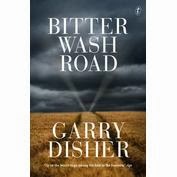
Garry Disher "Bitter Wash Road"
With Wyatt seemingly taking time out to recuperate and plan his next job and Hal Challis and Ellen Destry on hiatus it’s good to know Garry Disher is still churning out quality fiction.
I’ve tended to stick to a series once I find one I like, and both the above mentioned are right up there with the best of them, but based on what I read here I was straight out chasing other titles.
I couldn’t find Play Abandoned in iBooks or Kindle, so it’s off to the Libraries to chase them up, but Two-way Cut has duly been downloaded and added to the Read These list. The problem, based on the Bitter Wash Road experience, is that I’m likely to sit down to it one afternoon, have it finished before I go to bed that night and be up in the morning looking for another helping of tautly written, immaculately plotted quality crime fiction.
Set in the isolated South Australian wheat belt, an hour or so north of Clare, Bitter Wash Road runs with a fairly limited focus through the eyes of Constable Paul “Hirsch” Hirschhausen, a former Adelaide detective who has been returned to the uniformed branch and exiled to a one-man police station in the middle of nowhere in the wake of a corruption scandal. He’s a city cop pushed into a country lifestyle where his colleagues have their own way of running things and regard him, thanks to his involvement n the corruption case, as a whistleblower, dog, and maggot.
As things turn out, rather than being a whistleblower committed to justice Hirsch is a decent bloke who has chosen not to do the wrong thing, been caught on the edge of the investigation, which is ongoing through the plot line and adds a further degree of tension, and is being made to pay in much the same way as he would have been if he’d turned the wrongdoers in himself.
That’s a distinction his small town colleagues aren’t inclined to make, so things work out the same regardless of whether he actually blew the whistle.
Three hours north of Adelaide, Tiverton is a town south of the Flinders Range that’s doing it tough. Forty kilometres closer to the capital, Redruth is slightly larger and boasts a three man one woman police operation with Hirsch’s boss Sergeant Kropp and his male offsiders having carved themselves a nice comfortable niche, going about what they see as their duty with the casual arrogance of people who know and get on with everyone who matters.
The rest of the population, ground down by isolation, lack of opportunity and shrinking incomes won’t get in the way,
Or rather, they won’t, if they know what’s good for them.
It’s a community of haves and have nots, and if you’re one of the latter you don’t want a ticket for speeding, driving under the influence or (believe it or not) jaywalking.
At the start of the story, Hirsch is despatched to investigate gunshots that have been heard just out of Tiverton. He finds the culprits in the shape of a couple of bored kids taking potshots at jam tins with a .22, and is then redirected to the scene of what appears to be a hit and run on a back country road.
Teenager Melia Donovan is the victim, and as far as his colleagues are concerned it’s a clear case with an obvious explanation and enough time elapsed to make it impossible to track down a culprit. Hirsch, however, digs around, comes up with question marks, but is frustrated by the way crime scenes and associated evidence have been treated.
It’s much the same story when Alison Latimer, who has recently left her abusive husband and is seeking a divorce is found dead, in a location she detested in an apparent suicide. Hirsch has his doubts, but before he can do anything the scene, and her estranged husband’s homestead are rendered useless for anything approaching accurate forensic science.
But there’s enough there to keep Hirsch sniffing away, regardless of the hostility surrounding him, and he ongoing corruption investigation, with the internal investigations crowd determined to pin something on him and any number of disgruntled colleagues who’d be only too happy to assist in the attempt.
And, in the background, there are ongoing concerns regarding the overwrought media coverage of a couple of thrill killers roaming the outback in a black Chrysler station wagon.
As the narrative unfolds what looks on the surface like an exercise in low level small town corruption turns into an investigation with implications considerably higher up the pecking order and the picture becomes increasingly disturbing as the layers are peeled back.
Disher is a class act, and his books invariably exhibit strong plot lines, a diverse cast of characters who are rarely what they seem and enough twists and turns to keep the reader turning the pages.
Which, of course, is why I finished this one so quickly, and why I was out earlier this morning looking for more.
Hirsch’s situation might not be the sort of thing that can be parlayed into a series, but there’s definite potential there. The character and Disher’s narrative approach, which limits things to what you can see through his eyes have definite possibilities.
Monday, June 24, 2013
Carl Hiaasen "Bad Monkey"
Long term fans will come to Carl Hiaasen’s latest south Florida mystery knowing, more or less, what to expect, and while there’s something different in the approach (it’s as close as Hiaasen’s likely to get to a police procedural), and the plot line strays beyond the Florida state line (but only as far as the Bahamas) virtually everything else is reasonably familiar.
This time around Hiaasen’s protagonist is Andrew Yancy, who’s had issues with the Miami Police Department and now finds himself in the Sheriff's bad books in Key West after he assaulted the prominent dermatologist who's married to his future former girlfriend. He’s of the opinion that the husband had a bad case of bees up the bum, and had attempted to fix the problem, in public, with a vacuum cleaner. It was, apparently, all over YouTube in a matter of minutes.
As a result of a plea bargaining deal and a suspended sentence, he's been reassigned as a restaurant inspector, on the roach patrol and the things he finds in Key West kitchens is making him physically ill. He has, to all intents and purposes, stopped eating, and is also engaged in an ongoing struggle against a neighbour building a monumental spec house that contravenes the local planning regulations, will tower over his more modest home and cut off his view of the sunset across the Gulf of Mexico. It has already scared away the little Key Deer population.
In true Hiaasen fashion, the steps he takes against the neighbour involves scaring off potential buyers, planting dead raccoons, hives of angry bees, Santeria shrines, and, lastly, his ex-girlfriend and her new beau on the premises. He’s not above using his own misfortunes as well when he becomes entangled in another matter.
But that’s back story.
You know you’re in familiar territory as soon as you read the opening paragraphs:
On the hottest day of July, trolling in dead-calm waters near Key West, a tourist named James Mayberry reeled up a human arm. His wife flew to the bow of the boat and tossed her breakfast burritos.
After calming herself, Louisa Mayberry remarked that the limb didn't look real. 'Oh it's real,' said James Mayberry, 'Just take a whiff'. Snagging a fake arm wouldn't make for a good story. A real arm was major high-fives from all his peeps back in Madison. 'You caught a what? No way bro!'
The arm, as a DNA match reveals, belongs to entrepreneur Nicky Stripling, who made millions billing Medicare for nonexistent electric scooters called Super Rollies to non-existent senior citizens. Florida, the reader learns, is the Medicare-fraud capital of America, where the most experienced dirtballs came to gorge ... the slickest and slimiest — former mortgage brokers, identity thieves, arms dealers, inside traders and dope smugglers. Stripling’s done pretty well out of it (he’d socked away eleven-plus million dollars) but, if the severed arm’s to believed, has been lost at sea and ended up as a shark’s lunch.
Yancy, on the other hand, suspects foul play. The victim’s wife, who stands to inherit a fortune, doesn’t ring true and the victim’s daughter accuses her step-mother of doing away with her husband to collect the two million dollars’ insurance money. There’s also the possibility, if there is foul play involved, that he’ll get his old job back if he can crack the case.
That’s not the way his boss, Sheriff Sonny Summers (who won office because he was the only candidate not in federal custody) sees it. As far as he’s concerned, the severed arm needs to be delivered to the Miami Medical Examiners office, given the fact that Miami is the floating-human-body-parts capital of America, and the severed limb won’t do much for tourism in Key West.
Miami, on the other hand, don’t want it either. It doesn’t match any known victim, it was found outside their jurisdiction, and the currents probably wouldn’t have carried anything originating in or near Miami to the Keys, which, basically is why Yancy ends up with a human arm alongside the Popsicles in his freezer.
Oh, and the shark teeth embedded in the flesh are from an inshore variety that doesn't frequent the area where the arm was found.
The trip to Miami, however, hasn’t been a complete waste of time since it put him into contact with pathologist Dr. Rosa Campesino, who has a penchant for hot sex on a cold mortuary slab kinky sex in locations like slabs.
Meanwhile it seems Bonnie, his former girlfriend, who still seems to have the hots for Yancy, is really Plover Chase, a Tulsa English teacher who’s on the run after being convicted of extorting sex from one of her students in exchange for giving him an A on his report card.
Hiaasen novels tend towards the ornate when it comes to unusual subplots.
Yancey’s investigation has him moving back and forth between Key West, Miami and the Bahamas, which is where he meets the eponymous Bad Monkey, a nasty little creature named Driggs who’d been the official “Rally Monkey of the Los Angeles Angels” but lost the gig after a scrotum-grooming reverie, broadcast live on the stadium Jumbotron.
Sold off to a freelance animal wrangler, he’s ended up in the Bahamas as a backup to another, more docile simian, on one of the Pirates of the Caribbean movies but a repeat of the execrable antics that had cost him the Angels gig saw him sold for seventy-five Bahamian dollars to a sponge fisher who passed him on to a gullible fisherman named Neville Stafford.
Living on a diet of batter-fried chicken, conch fritters and coconut cakes, Driggs loses most of his hair and is traded to voodoo priestess the Dragon Queen when Neville needs a spell cast on the property developer who’s managed to bump him off his property, which is about to become part of a timeshare resort.
The property developer appears to be Stripling’s widow’s new boyfriend, which, of course, adds to the suspicions about her husband’s death, and that’s about as far as we can go without crossing over into spoiler territory.
Bad Monkey mightn’t be Hiaasen at his best (I had a feeling all the way through that I’d enjoyed other titles more, but nothing concrete to base that suspicion on) and might lack the outrageousness that lands on the page as soon as The Skink appears on the scene but it’s still a wickedly funny read where the good guys, despite everything outrageous fortune and the weather can throw up against them, ultimately prevail.
You knew they would, of course, and though the outcome isn’t really in doubt it’s the journey that delivers the reader there that makes a Hiaasen novel an ingenious entertainment.
Saturday, June 1, 2013
Peter Robinson Friend of the Devil
Typical, really. Having watched the DCI Banks episode based on Playing With Fire I figured I’d read Friend of the Devil before watching the adaption, and found I probably needed to reread two more Robinson titles, one of which appeared at the time to be a non-Banks title.
This, of course, comes after putting the reread them all in order (I’d only covered the first title, so it wasn’t as if that had progressed too far) project on hold while I watched the adaptions. Having recently read (or having your review available to consult) Aftermath (five titles earlier in the Banks sequence) and Caedmon’s Song (the non-Banks title that goes back well before the two Banks titles) probably isn’t totally necessary, but since the two stories link into what’s going on here it’d help keep things tidy.
The link to Aftermath, #12 in the series (this is # 17) is pretty clear from very early in the piece since Karen Drew, the quadriplegic victim found on an isolated cliff near Whitby still sitting in a wheelchair with her throat slit turns out to be Lucy Payne, the partner in crime of Terrence Payne, the perpetrator of a series of sadistic crimes committed against girls lured to what was later dubbed The House of Payne. He died of injuries inflicted in the process of apprehending him, while Lucy jumped through a window and damaged her spine while trying to escape arrest.
Until the previous identity is revealed there’s nothing obvious about Karen’s past that would explain the murder because, basically, when Annie Cabbot starts digging around looking for a motive, there isn’t much of a past. The cover story has Karen Drew left in the wheelchair as the result of a car crash, and it’s the search for motives for her murder that leads Annie to the firm of lawyers who looked after her affairs and provided the cover story.
Explaining away a quadriplegic’s background would seem to be a fairly straightforward affair if the person you’re doing it for is unable to communicate or do anything to blow the cover story, but someone seems to have let the cat out of the bag. That breach of security, wherever it was, has allowed an alleged acquaintance called Mary to sign Karen/Lucy out the nursing home and do away with her, leaving the body to be found by some innocent passer by.
DI Annie Cabbot has been temporarily seconded to Eastern Area Headquarters, and seems, on the surface at least, to be in severe danger of unravelling completely. The phone call that alerts her to the murder finds her waking in a strange bed after a one-night stand with a much younger man and she’s self-medicating like it’s going out of style almost throughout the investigation.
And the same Mothers' Day morning Chief Inspector Alan Banks, with his only scheduled commitment being the obligatory call to Mum has his leisurely morning interrupted by a phone call from Detective Inspector Kevin Templeton reporting the discovery of a scantily clad nineteen-year-old girl’s body in The Maze, a complex tangle of narrow cobbled alleyways behind the market square in Eastvale, right across the Market Square from the Eastvale police station.
Eastvale College student Hayley Daniels may have been attractive, with any number of admirers, but she’s also inclined towards outrageous behaviour, which means she’s not going to wait till her friends arrive at the next location before voiding the bladder after a group of yobs trashed the toilets at The Fountain. After giving the bartender a mouthful she departs, along with the rest of her party, announces she’s going to relieve herself in the warren of alleys. Her partly clad body is found in the storeroom of a leather goods shop when the proprietor opens it in search of offcuts the next morning and Banks finds himself looking at rape and murder on an alcohol-fuelled Saturday nigh with any number of suspects, from the crowd she’d been partying with, through older men who had ogled her at the pub (including the one who found the body) to a lecturer at the college.
The closed circuit TV footage shows Hayley entering the Maze on her own, and a scan of the earlier images fails to reveal anyone entering the area earlier, though there is another entrance where the camera coverage isn’t as good. On that basis, the obvious conclusion is that there’s someone lurking in there waiting for a victim, Jack the Ripper style, and as far as Kevin Templeton’s concerned that’s where the explanation lies.
Crass, uncouth, insensitive with a hide equivalent to a rhinoceros, and more front than your average supermarket, Templeton has managed to get everyone he works with, apart from Banks who’s still 50/50 on him, and decides to conduct a one-man stakeout in The Maze, a decision that ends up costing him his life. His death, however, brings the two cases together since he’s found with throat is slashed from behind a la Lucy/Karen.
The answer to the Lucy/Karen/Templeton side of things turns out to lie in the 1989 disappearance of a man believed to be the serial rapist and killer of half a dozen young (the main plot line of an earlier non-Banks title, Caedmon’s Song). Along with the disappearance there’s an unsolved death and a vicious attack, and all three happened in and around Whitby.
At this point, again, we’re teetering on the brink of spoiler territory, but we knew the two main investigations were going to merge, because Robinson has them unfolding in parallel, switching back and forth between the two from paragraph to paragraph rather than chapter to chapter. In a lesser writer this approach could become confusing, but Robinson has the writerly chops to make it work, and the close to seamless integration of the twin narratives provide the chance to drive the soap opera side of things on a bit further.
In the big picture Friend of the Devil is as much about the long-lasting aftereffects of physical and psychological trauma and serious crime on both victims and survivors as it is about the two cases and when the cases are finally solved it’s hard to disagree with the explanation offered by Lucy/Karen’s killer for what would seem to be a cruel and totally unnecessary killing. That’s not to suggest I’m inclined to agree, either, but it’s one of those situations where you can see where they’re coming from.
That sort of big picture dark side of human emotions and motivations can become very heavy very quickly, which is why we need the light and shade that comes with the soap opera interactions of the regular cast of characters. Banks and Annie are still feeling the fallout from their emotional entanglement, Banks is still rebuilding his life and getting over the aftermath of Playing With Fire and there are little subplots involving Jamaican Detective Constable Winsome Jackman, Detective Sergeant Kevin Templeton (the wake following his death catches the rather complex web of emotions surrounding his death rather well) and Banks' demanding boss, Superintendent Catherine Gervaise.
Bring all those strands together and the result is an absorbing read that maintains the suspense right up to the end and left me interested to see how the transition to the small screen was going to be managed.
Labels:
Chief Inspector Banks,
Crime,
Peter Robinson,
Yorkshire
Thursday, May 30, 2013
Henry Scott-Irvine "Procol Harum - The Ghosts of A Whiter Shade of Pale"
There’s a delicate balance that comes with the territory when someone ventures into the realm of music biography. If you’re writing about anyone below genuine superstar status, where almost anything anyone might want to know is already out there in the public domain you’re going to need to consider the demands of three different and quite distinct audiences.
Take a group like Procol Harum, and you’ve got a perfect encapsulation of the issue.
The first sector of the audience are the casual fans, the people who, in this case, would recall A Whiter Shade of Pale, note that they liked it, had always wondered what it was about and had always wondered about the band who took it to the top of the charts back in 1967. It’s a group who’ll find Procol Harum - The Ghosts of A Whiter Shade of Pale an interesting read, since Henry Scott-Irvine covers the band’s early history back to Gary Brooker's first outfit, The Paramounts, the Southend R&B band who might have garnered high praise from the likes of The Rolling Stones and The Beatles (who they opened for) and Sandie Shaw (who they backed on tour).
The circumstances that brought about pianist and singer Gary Brooker’s songwriting partnership with lyricist Keith Reid are covered thoroughly, as is the courtroom fallout when A Whiter Shade of Pale hit the top of the charts and former members of the band jumped in for a share of the proceeds and the more recent law suit launched by organist Matthew Fisher some thirty-eight years after the event claiming a share in the copyright as a co-writer of the multimillion-selling song that continues to generate a strong stream of royalties.
The casual fan may well be surprised to learn that, between the original release of AWSoP and the court case Procol Harum released a string of fairly highly acclaimed albums (Shine on Brightly, A Salty Dog, Grand Hotel), toured extensively, produced some of the earliest (and best) rock collaborations in an orchestral setting and were a major drawcard in the United States through the seventies, though their prog rock credentials didn’t count for much when the punk rockers hit town.
One step up from the casual fan is the bloke who, much like myself, has heard the albums, has a bit of the sense of the chronology and wants to be reminded of the detail. Again, Scott-Irvine does a rather good job in that regard, carrying the narrative forward through the personnel changes, money problems that stemmed from dodgy management, legal costs and, in places, downright bad luck. They could, for example, have played Woodstock, but they’d already played a string of festivals that American summer and opted to head home instead.
By the book's end we're brought right up to the current incarnation of the band, a capable and congenial musical unit touring the world, dispelling ghosts as they go
It’s not, however, a book for the obsessive fan, the Procol Harum Trainspotting Anorak. While it’s an interesting, easy and enjoyable read there isn’t a great deal here that wasn’t either known or suspected. It’s quite possible the unknown and unsuspected only exists in minimal quantity, but there’s definitely room for a detailed album by album discussion of the contents of a significant though largely ignored or forgotten musical legacy.
One thing that does come across strongly is the deliberate modelling of the Procol Harum instrumental lineup on the dual keyboards piano/organ combination employed by Bob Dylan and The Hawks (later, of course, The Band) at Manchester’s Free Trade Hall and elsewhere on the 1966 World Tour, along with the influence of The Young Rascals.
There’s at least one intriguing side note that I, for one, would have thought was worth checking out. Joe Boyd’s White Bicycles has Procol lyricist Keith Reid turning up on the doorstep of Elektra Records’ London office (Boyd was the label’s British rep) looking for a deal based solely on some typewritten verses. I found him amiable but crazy. Who ever signed someone on the basis of a few stanzas of doggerel? (White Bicycles Kindle edition, Location 2116) and Boyd booked the band to play London’s UFO Club the evening 'A Whiter Shade of Pale' was released, which rates a mention here as the band’s live debut and has Reid mentioning the visit at the time, though there’s no earlier reference to the incident.
Trainspotting, perhaps, but it’s an intriguing incidental that I thought was worth a wry paragraph.
Equally interesting, on a similar maybe over the top but definitely intriguing note was the similarity between The Paramounts’ origins (Southend is right on the Thames estuary, and merchant seamen brought in obscure rock, R&B and blues titles unavailable in England through standard record shops) and the likes of The Beatles (Liverpool) and The Animals (Newcastle-on-Tyne). There’s a brief mention of groups of their ilk playing songs they’d discovered on imported records here, but it’s an intriguing point that might have been worth exploring further.
I’m also intrigued by a couple of passing references to the late, great Vivian Stanshall, also a native of Southend, who must have had some link with the Paramount/Procol scene apart from a co-write with Keith Reid referred to here.
But that’s nit-picking. As a reasonably detailed biography Procol Harum - The Ghosts of A Whiter Shade of Pale does everything you’d expect it to do if you’ve read a number of similar volumes, it’s reasonably detailed but with a lot skimmed over, covers all the major points but could do with a bit more depth.
There’s no doubting the depth of Scott-Irvine’s research, and the extensive list of interviewees include practically everyone who has ever been involved with Procol Harum (the notable exception being the late BJ Wilson, who died before the project started), producer Chris Thomas, Cream lyricist Pete Brown and Led Zeppelin's Jimmy Page. He doesn’t skirt around the Matthew Fisher lawsuit, though it’s subject matter that’s always going to be a little more than merely contentious and the inclusion of court documents in the appendix section of the book gives the reader the opportunity to explore the matter if you’re so inclined and find the content in the book itself lacking in detail.
There’s a fairly thorough discussion of the band’s groundbreaking orchestral concerts, Gary Brooker's solo ventures and side excursions with the likes of Eric Clapton and Bill Wyman, you get to read the long lost third verse of A Whiter Shade of Pale (not that I was much the wiser after I’d done so) and the volume sports the regulation big name contributions (Foreword by Martin Scorsese, Introduction by Sir Alan Parker and Afterword by Sebastian Faulks).
All in all, one of the better examples of in-depth rock biography for the general fan, though the old anorak may find the mileage varying.
Wednesday, May 29, 2013
Peter Robinson "Playing With Fire"
The reread the DCI Banks series from go to woah scheme comes rather drastically unstuck here, thanks to the British ITV series that delivered a rather heavily modified Playing With Fire and had Hughesy reaching for the bookshelves to check the intersection between the written and dramatised versions of the plot line, and I guess the same thing will be happening after I’ve iViewed the remaining episodes from the first series (Friend of The Devil and Cold is The Grave).
The actual object of the whole exercise is to keep track of the titles in an extensive series, and it had been a while since the first run through Playing With Fire. While you’d expect a few differences I wasn’t quite prepared for the major transformations in Robert Murphy’s adaptations, and they worked well enough though he’s done a couple of things that have implications for the ongoing soap opera side of things.
What hasn’t changed is the core of the case, where a deliberately lit fire in two barges moored end to end on a dead end canal ends up linked to an art fraud. The fire claims two victims, a reclusive artist and a teenage junkie, and while the modus operandi involved in the art fraud remains the same, there are significant differences between the two versions.
One thing that hasn’t changed is the ongoing shake out after the end of Banks’ affair with his offsider, DI Annie Cabbot in an environment where keeping their professional relationship viable is going to be a major issue, particularly when Annie launches herself into an involvement with a handsome art authenticator, who would appear to be a useful source when it comes to assessing what may well be forged artworks. Useful, that is, as long as Banks can contain a degree of jealousy and a suspicion that there are things about Philip Keane that don’t quite add up.
Of course, right through the police procedural genre things aren’t quite the way they seem, and sorting out the realities behind the situation is almost invariably the key to solving the case.
The squatter living on the first barge, reclusive and unsuccessful artist Tom McMahon, looks to have been the target of the arson attack. The second victim, teenaged heroin addict Tina Aspern, was estranged from her mother and stepfather so there are obvious issues there.
Her boyfriend, troubled day labourer Mark Siddons, was found near the fire scene, tried to escape but was caught and interrogated, revealing that he’d quarrelled with Tina and left her alone with her fix while he headed out for a night on the tiles which has delivered a strong alibi in the form of the Leeds University student he ended up spending the night with. Mark adds another aspect to the investigation when he suggests Tina’s addiction stems from the fact that she had been abused by her stepfather, Doctor Patrick Aspern.
He’d hoped to rescue Tina from the depths to which she had sunk, and his attempts to escape the remorse and grief associated with her death provides another narrative strand that weaves around the investigation.
Another obvious suspect comes in Andrew Hurst, the obsessive collector who reported the blaze. In his account, having noticed the flames, he rode his bicycle down to the blaze, rode back to phone the fire brigade and returned to watch them put the fire out. Fair enough, you might think, but you suspect there’s a bit of perving going on and he’s washed all his clothes by the time Banks and Cabbot arrive to interview him.
Then there’s Leslie Whitaker, owner of an antiquarian book shop who sold McMahon old books that could provide paper suitable for forged Turner watercolours, quite possibly a man with something to hide.
Suspicions are on the rise two days later when a second fire in a caravan parked in a relatively remote spot in the countryside claims the life of Roland Gardiner, a down-and-out failed business man but fails to damage a fireproof safe containing a large amount of cash and what appears to be a Turner watercolour.
There’s no doubt the fires were deliberately lit, and the modus operandi seems much the same, so the answer to the case would seem to lie in establishing the connections between the two and unearthing the identity of a third participant in the art fraud scam, who is more than likely going to turn out to be the culprit.
As Banks and Cabbot go about doing that, Mark Siddons goes on a cross country trip that spins things out a bit and there are the regulation dead ends, clues, red herrings and side issues before circumstances rather than deduction lead to the identification of the cunning and calculating villain who’s a thoroughly nasty piece of work and sedates his victims with a date rape drug before setting the fire, using a candle as the seemingly innocent timing device to start the blaze. He has also covered his tracks rather well, using a rented car to approach the scenes of the crimes and arranging the rental using the identity and, more significantly, the credit card details, of a man long since dead.
The astute reader may or may not have spotted him earlier on, but even if that’s the case the rush of action that leads up to the conclusion keeps those pages turning, almost of their own volition. It’s an ending that sets things up for a couple of new strands in the soap opera ongoing interactions side of a good, solid police procedural series where the characters work as a group with its own internal dynamic as the cases they investigate tend to involve the darker recesses of the human mind.
Sunday, May 26, 2013
John le Carré "A Delicate Truth"
I have a feeling, assuming there’s someone there with the inclination to do the writing, that when twenty-second or twenty-third century historians turn their gaze back to concepts like liberal democracy and the Westminster system of government they’ll identify the early years of the twenty-first century and the agendas some of the characters in this latest le Carré are pursuing as the era and the agency that more or less killed them off.
That’s not to suggest that liberal democracy, characterised by fair, free, and competitive elections between multiple distinct political parties, a separation of powers into different branches of government, the rule of law in everyday life as part of an open society, and the equal protection of human rights, civil rights, civil liberties, and political freedoms for all persons (Wikipedia), or the Westminster system, where the Prime Minister ... leads a Cabinet which is responsible to the lower house, ... a career public service ... impartially serves the government of the day ... The armed services are outside of politics and act on the instructions of the government and The rule of law prevails, with an independent judiciary, subject to the Constitution (source) always operated as advertised.
At the start of A Delicate Truth, Operation Wildlife, a 2008 top-secret mission involving the CIA, British special forces and American mercenaries from Ethical Outcomes, a private security operation, aims to exfiltrate an arms dealer in league with jihadist terrorists visiting the British colony of Gibraltar.
It’s a covert extraordinary rendition operation instigated, on the basis of information received, by bullying New Labour junior minister Fergus Quinn, a marooned Blairite of the new Gordon Brown era who, given the nature of the beast, can’t afford to be directly connected to it. Quinn might have little time for the Foreign Office establishment, but he needs someone there on the ground, and recruits a middle rank civil servant in his fifties, an honest-to-God Foreign Service dobbin, gives him a cover identity as statistician Paul Anderson, and packs him off to Gibraltar believing he’s doing his bit for Queen and country in the war on terror.
Once he’s on the ground there he’s confined to a hotel room, going stir crazy and unable to comprehend why he can’t get out and about. Then, when he’s finally released it’s straight onto the side of The Rock, where he meets Jeb Owens, seconded on the quiet from the British military and not entirely gruntled about being involved on the fringe of what is, basically, a mercenary operation.
Things don’t run the way they’re supposed to, the Foreign Office dude, who’s not quite the eyes and ears and, significantly, not allowed to deliver a yea or nay and the military bloke smell a rat, advise against continuing the operation, get overruled by Quinn, and once things are over Paul is told everything went off without a hitch, bundled onto a homebound flight and transformed back into British diplomat Christopher (Kit) Probyn.
The reward for his service comes with an appointment as High Commissioner to a couple of Caribbean states, a knighthood and the wherewithal to fund an idyllic retirement in North Cornwall. Sir Kit attends the annual fayre at his Cornish village, presides over the proceedings as the lord of misrule and unexpectedly comes across Jeb Owens, the Special Forces leader seconded to Operation Wildlife. He’s ended up in Post Traumatic Stress Syndrome territory after an operation that, rather than the unqualified success Probyn had been led to believe, turns out to have been an utter cock-up in which an innocent Muslim mother and child were killed.
Probyn, by nature, wouldn’t be the most committed of whistleblowers, but the manner in which Jeb Owens makes him aware of the utter cock-up, a note purporting to be a receipt for a purchased handbag (Owens has become an itinerant leather worker) found by Probyn’s wife (on the mend from major health issues, so she needs to be reassured) and the involvement of their daughter Emily, a doctor in an East End hospital means he’s going to be kept on task.
When Probyn starts probing the issues he runs across conscientious Foreign and Commonwealth Office idealist Toby Bell, who served as private secretary to Fergus Quinn in the lead up to Operation Wildlife. Toby is out to make a difference ... in a post-imperial, post-cold-war world and becomes increasingly suspicious of Quinn’s dealings with US private intelligence firm Ethical Outcomes, initially through dodgy former British spook Jay Crispin (Third son of a posh Anglo-American family. Best schools. Sandhurst at second attempt. Ten years of bad soldiering. Retirement at forty. We're told voluntary, but one doubts it. Bit of City. Dumped. Bit of spying. Dumped. Sidles up alongside our burgeoning terror industry. Rightly observes that defence contractors are on a roll. Smells the money. Goes for it. Hullo, Ethical Outcomes) though the dealings go all the way up to Mrs. Spencer Hardy of Houston, Texas, better known to the world’s elite as the one and only Miss Maisie.
Toby realizes his minister is hiding something important from him, begins to dig until he uncovers the details and gains the vital evidence by recording a secret meeting on the Cold War era reel-to-reel tape recorder no one thought to remove from the desk he occupies. Sticklers and hair-splitters would no doubt carp about the fact that the ancient device works faultlessly after all these years, but one suspects it was a rather expensive top of the range model that could well have received a biennial service for much of its existence.
Armed with the evidence, Toby goes to diplomat Giles Oakley, who’d been, up to this point, his guardian angel and was largely responsible for Bell’s landing the job in the first place. For his trouble he finds himself suddenly transferred to Beirut while Fergus Quinn suddenly exits the world of politics.
Now, three years later Bell, who le Carré sees as the striving ambitious fellow I fancy myself to have been at much the same age, until I went and messed everything up by writing The Spy Who Came in from the Cold, is back in London, having served his penance, and happens to be writing a novel. There’s also a bit more than a dash of the author in Probyn, apart from the fact that both author and protagonist live in rural Cornwall.
The problem for the would-be whistleblowers, of course, is that by trying to lift the lid on the details of a botched operation and bring its authors into the spotlight they’re meddling in matters that a secret state that relies on plausible deniability and subcontracts out its dirty work to maintain that deniability would prefer to leave under the carpet, so we’re headed straight into classic conspiracy thriller territory, as the meagre forces of good and righteousness race to assemble evidence before they can be silenced, which leads to the inevitable climax.
The sirens multiplied and acquired a more emphatic, bullying tone. At first they seemed to be approaching from one direction only. But as the chorus grew to a howl, and the car brakes screamed in the street outside, Toby couldn’t be certain any more - nobody could be certain, even Emily - which direction they were coming from.
That’s the final paragraph, and you might regard quoting it as verging on spoiler territory, but you knew (or at least I can claim that I did) that it was always going to end in tears. Like most of the key events in the plot line, the consequences are kept offstage, which only adds to the underlying menace that lies behind the seemingly affable old-boy mentality that appears to operate among the upper echelons of Her Majesty's Foreign and Commonwealth Office.
That’s familiar territory for long term le Carré fans, but the ground rules and the goal posts, in the wake of 9/11, the Iraq War and the Global War on Terror, have been moved. While the likes of Giles Oakley have been there all along, they’re smart operators who can read the changes in the wind and are all too willing to climb aboard the neo-con bandwagon. That means, despite the traditions associated with their own armed forces they’ll go along with the outsourcing of sensitive matters like Operation Wildfire to private contractors in it for the money.
As le Carre puts it here, It’s so much easier if I come to you and say, ‘Here’s the contract, I want you to liberate Sierra Leone, I don’t give a toss who you take with you and try to keep the killing down.’
Or, in the words of Fergus Quinn as early as Page 23 of the iBooks eText: Private defence contractors… Where’ve you been? Name of the game these days. War's gone corporate, in case you haven't noticed. Standing professional armies are a bust. Top-heavy, under-equipped, one brigadier for every dozen boots on the ground, and cost a mint.
So, as the lines between public and private interests become blurred there’s an ever-expanding circle of non-governmental insiders from banking, industry and commerce who were cleared for highly classified information denied to large swathes of Whitehall and Westminster (p. 414), all of whom have a vested interest in ensuring there’s no one out there asking difficult or embarrassing questions.
That’s not to suggest that Le Carré’s Deep State, the inner core of the establishment, enjoys a monopoly on shortsightedness, hypocrisy, lies and unfettered greed, and it’s not as if a ruthless determination to protect their own self interest is a recent development.
You can see le Carré’s pursuit of hypocrisy, cant and double-dealing among the political and administrative elite as a theme running through all his work, but faced with recent developments on the world stage, as le Carré put it in an essay in last month’s issue of Harper’s, How far can we go in the rightful defence of our Western values without abandoning them along the way?
And that, of course, is what A Delicate Truth is all about.
Wednesday, May 15, 2013
Stephen Booth "Dead and Buried"
Long term readers probably suspected it all along, but there’s a rather interesting little piece here where author Stephen Booth recounts his introduction to the key characters in a series that has run out to twelve titles with a thirteenth out in June.
It as, it seems, a quite deliberate plan, though the two characters Ben Cooper and Diane Fry, were, in Booth’s explanation seen from a distance, with a few basic impressions and subsequently, one imagines, Booth had room to move and twist things around as their true personalities emerged through the series.
He had his setting in Derbyshire’s Peak District, wanted to avoid another Rebus or similarly old, embittered world-weary, middle-aged detective inspector, so the two characters needed to be young and junior ... on the bottom rung of the ladder in CID. Given the location he wanted them to have differing points of view, and, by extension, different ambitions, though he figured a little role reversal was in order. Given the need for one to be local, the other an outsider, one sensitive and the other hard-nosed, one ambitious and the other less aspirational a bit of gender role reversal had Cooper as the sensitive, happy to stay where he was brought up local and Fry as the hard-nosed ambitious outsider.
It’s a combination that worked well enough to have the Booth titles move from grab the next one when it hits the shelves in the local library to chase down the next title once you’re aware that it’s out there.
After eleven titles there’s a fair bit of development from that original glimpse, and by Dead and Buried Diane Fry’s on the way up the promotion ladder having worked her way up to Detective Inspector in the Major Crimes Unit, with Detective Sergeant Cooper happily about to settle down in the old familiar location, in the process of setting out the arrangements for his wedding.
Crime scene officer Liz Petty seems almost totally focussed on her big day, and Cooper’s finding the whole thing a distraction as he sets about dealing with two seemingly unrelated cases as the Peak District of England goes up in flames as wildfires, probably caused by arson, spread across the moors. They’re the worst seen in the area in decades, and the fire crews are flat out.
Firemen fighting one such outbreak sight signs of a break in at an abandoned and not quite derelict pub, Cooper heads out to investigate. The Light House, located on an out of the way moorland road, closed its doors two years before and turns out to be the key to the whole thing, but Ben’s not quite inside when he’s alerted to what seems to be a much more significant discovery.
Fire fighters report finding a buried rucksack and a leather wallet out on the moorland, and since there’s a not quite cold case involving the disappearance of David and Trisha Pearson, a couple of tourists reported missing two years previously who seem to have disappeared without trace in the middle of a snowstorm. At the time they vanished there had been some controversy, with allegations of financial improprieties that may have prompted a staged disappearance.
Under the circumstances this seems much more important than investigating a reported break in.
Which, of course, is what Cooper should have done since the reader already knows there’s a body in there (thanks to the opening sequence). The possible link to the missing couple brings the Major Crimes Unit into the picture and, predictably, the body we knew was there is found by Diane Fry, providing ample excuses for her to start heaping grief on her former colleagues. There are some major issues in Fry’s past, as the long term reader is well aware, but, really, she seems to be turning into a genuine, dyed in the wool B with a capital itch. as far as she’s concerned she’s finished with her former colleagues in the Peak District, has definitely moved on with an eye to the future and is going to resent any circumstance that might drag her back.
So while she’s sniping at the former colleagues some of them, most notably the close to retirement and therefore increasingly disinclined to worry about upsetting his superiors old-school copper, Gavin Murfin, are sniping right back.
As the investigation starts to focus on the now derelict Light House we meet former landlord Maurice Wharton, whose stock in trade involved insulting his customers, and is now facing terminal illness. The two strands, inevitably, wind up intertwined and are brought together in an unexpected and harrowing climax that opens a number of soap opera possibilities for the next instalment, Already Dead, due to hit the market in June.
Saturday, May 4, 2013
Donna Leon "The Golden Egg"
I read Wasting no more words on her Brunetti left the hospital to go and get the boat to the Lido to go for a walk on the beach, turned the page and came to the regulation copyright notice one finds at the ends of certain brands of e-book. “Hang on,” I thought, “there’s something missing here.”
A reread of the final couple of pages, however, revealed Donna Leon had nothing more to say on Commissario Brunetti’s investigation into the death of Davide Cavanella, a deaf and mentally disabled man who worked in Brunetti’s neighbourhood dry cleaner because, basically, there was nothing more to say. Another author might have been tempted to moralise or comment, but with the mystery explained the rather matter of fact Brunetti is off for a walk on the beach.
Not that his stroll is likely to be particularly enjoyable. The story starts with the first leaves of autumn beginning to fall, and the investigation doesn’t take that long, but an autumnal, a cold, wet Venice, with the architecture shrouded in grey sheeting mizzle is probably the right setting for Brunetti to brood over the depressing details of what he’d found.
A lesser author would take the reader out to the Lido, deliver the protagonist’s melancholy meditations and belabour the moralisations. Readers who’ve been aboard for a while, however, will have a fair idea of the trend Brunetti’s thoughts would have taken and a definite opinion about what he’d have gone on to do afterwards.
That, of course, is probably either what he’d done once he’d taken the initial steps that needed to be taken after the latest self-serving directive from Vice Questore Patta (asked Vianello if he’d like to come for a coffee) or, if the time was right, head home for lunch or dinner with his wife and family, drink a little wine and possibly read a little Tacitus.
Patta’s request involves Brunetti looking into a seemingly minor violation of the public vending regulations committed by the business partner of the mayor’s future daughter-in-law. It’s an election year, Patta’s out to avoid any hint of a scandal and Brunetti, while he has no desire to help Patta consolidate his political connections, has no choice but to follow the directive, which is, basically, to find out if the vigili involved are trustworthy.
The vigili urbani, for those who mightn’t be quite up with the terminology, are the unarmed officers whose job it was to see that city ordinances were obeyed. In this instance they seem to be ignoring the tables set up outside a shop in Campo San Barnaba that sells masks, next to the one with the expensive cheese (Brunetti lives nearby and knows the area fairly well) and it’s possible the proprietors of the mask shop don’t have all the permits to use that space. A petty matter, but where Patta’s concerned, par for the course.
Brunetti delivers the task of making a discreet inquiry to a junior officer before heading off with his right hand man for a coffee, learning, along the way that Vianello’s concerned about the ecological implications of his wife’s proposed holiday in the Seychelles. A farm stay hotel in Umbria’s more his style.
Brunetti passes through Patta’s antechamber to compare notes with an increasingly subversive Signorina Elettra (Why do we tolerate this ... and not go after them with clubs?) on the way back, and arrives in his office to find the phone ringing. It’s his wife, Paola, informing him of the death of the boy who doesn’t talk at the dry cleaner’s.
Although he was actually aged over forty, a deaf mute with the intellectual age of a child, as far as the neighbourhood was concerned he was the boy who helped out at the dry cleaner’s, and nobody knew his name or anything much about him. He seems to have died as the result of an accidental overdose of his mother's sleeping pills, having presumably swallowed a handful because they looked like candy. Paola can’t help being distraught at the thought that he lived a joyless life and died without anyone noticing him, helping him or understanding his situation.
But when Brunetti starts making a few inquiries about Davide Cavanella a number of intriguing issues raise their heads, centred around the question of how a man in his forties could have passed through several decades without leaving anything in the way of a paper trail. There’s no birth or baptismal certificate, no passport, no driver’s license, no credit cards and he never seems to have visited a doctor or been enrolled in the school system. In short, there’s nothing that might serve to verify that he actually existed.
That’s strange, because given the obvious disability issues, both he and his mother would have been entitled to financial support from government programs designed to help the disabled, and in a country where unethical claims for state assistance are rife, he’s a disabled person for whom no claims were ever lodged.
According to Ana Cavanella, who doesn’t want to discuss the death at all, her son’s papers were stolen years ago, and it’s obvious there’s much more to the story than she is letting on. There’s an extra complication since she lives in a working-class neighbourhood where the state is the enemy, and when the police come around asking questions the neighbours become as deaf and mute as the subject of the inquiries.
As the clues start to stack up, Brunetti comes to believe the death may not have been an accident and suspects the wealthy Lembo family, aristocratic copper magnates who employed Ana Cavanella for many years and Brunetti gradually draws out the information he needs to form the full picture of Davide Cavanella’s existence.
Along the way, of course, he has this other issue with Patta’s request, and there’s also a move afoot to remove Signorina Elettra from her current office and install Patta’s loathsome offsider Lieutenant Scarpa as his official receptionist. That won’t do at all, and Brunetti manages to find a means to prevent it.
But the main issue is the Cavanella case, and while Brunetti might have embarked on the inquiry expecting to find nothing suspicious, what he stumbles across instead is chilling, calculating and deeply disturbing.
Disturbing enough to have Brunetti, once he’s sorted things out in his own mind (there’s nothing much he can do in any official sense) setting out for a brooding walk along a wind and rain swept Lido.
The Golden Egg might seem to be a relatively low-key affair for much of the story, but there’s a sting in the tail and along the way the reader comes across all the elements we’ve come to expect in a Donna Leon story. Brunetti’s family and colleagues go about their business, providing the opportunity for evocative references to Venetian history and architecture, moody ruminations on Italian politics and society, and the regulation descriptions of the city’s food, weather and social life.
It’s Number Twenty-two in the series, and shows an author who doesn’t seem to be running out of steam. Remarkably, given the longevity of the series, for my money it’s getting better.
Tuesday, April 23, 2013
Colin Cotterill "Grandad, There's A Head On The Beach"
You would, I guess, start thinking something was afoot if you happened to find a severed head on the beach while walking the dogs in the morning. Based on that assumption, you’d probably have the alarm bells ringing if you wandered in to the local constabulary to report your find and realise they don’t appear to be particularly interested in your discovery.
So I guess you wouldn’t need to be an unemployed crime reporter forced to move to a remote coastal area of Thailand when your mother sold the family house and invested in a rundown resort on the Gulf of Siam to be scratching your head and wondering what was going on.
Jimm Juree, as we know from Killed At The Whim Of A Hat was well on her way to becoming the head crime reporter for the Chiang Mai Mail, and her talents are definitely under-utilised in her role as chief cook, bottle washer and dog walker at the tumbledown Gulf Bay Lovely Resort, located on a sliver of land betwixt a river and the deep, gray sea.
It's always a bother to decide who to tell when you find a head on the beach. I mean, there is no protocol. And when I say "always" here, I may be exaggerating somewhat because I can't say I've stumbled over too many heads on my morning dog walks. I'd seen body parts in morgues, of course, and accident scenes, but that Wednesday was my first detached head. It upset me that it hadn't upset me enough.
Having found the head, reported the discovery and noted the reaction (or, rather, the lack thereof) she’s bound to go seeking the facts. Having identified the head as belonging to a deceased Burmese, the local police are uninterested in the head, and have no intention of investigating who it belonged to, or the reasons for its appearance on the beach. Two rather nasty aggressive goons from the Southern Rescue Mission, a dubious charitable foundation whose duty it was to facilitate the journey of the soul to a better place arrive in a black SUV to take the head away, inform Jimm and Arny (her weightlifting brother) that they hadn’t seen anything and return to lob a grenade into the freezer in the Resort's shop after Jimm’s ex-policeman grandad Jah takes a pot shot at them to hasten their departure.
Outraged at the official unconcern and intrigued by what’s coming to light, Jimm sets out to crack the puzzle and ends up in the middle the Gulf chasing down an international slavery ring that operates with the connivance of the local police and the aforementioned dodgy charity. It’s a serious human rights problem involving a Burmese underclass, many of whom are in the country illegally.
There’s nothing unusual about the oppression of groups of foreigners whose presence in the country has a large legal question mark over it, but Jimm’s part of Thailand isn’t exactly an affluent area, and where the local population isn’t far above subsistence level the plight of the immigrants is shocking. In this case, the Southern Rescue Mission thugs are press-ganging Burmese workers to work on deep sea trawlers whose owners have powerful connections.
In such circumstances the Burmese aren’t inclined to say much but, with the help of an interpreter, Jimm discovers several have just disappeared, leaving their possessions behind, and manages to get a bearing on where the slave ships are working.
From there it’s a matter of figuring out how to expose the evils of the human trade and bring the perpetrators to justice, which isn’t going to be easy given complicit officialdom and heavily armed thugs on the vessels they’re after, but she manages it (of course).
Spoiler issues bring us to a halt at this point, though there’s probably no harm in revealing that the means by which Jimm manages to do it has something to do with the fractured karaoke mondegreens found at the start of each chapter.
But the head isn’t the only strand in the plot line. A second involves two elegant women who could obviously afford a better class of accommodation than the family's seaside resort, a mother and daughter combination travelling in a car without number plates and a very flimsy explanation for the absence.
They are obviously running from something and the daughter claims they are hiding because her father is one of the leading activists against the yellow shirt yuppies occupying Government House in Bangkok, in an antigovernment protest. Tis is the sort of situation where Jimm’s transgender computer whiz sister Sissie comes into her own, and while Sissie discovers the daughter had won a scholarship to study science in the USA but disappeared before collecting her diploma this doesn’t explain why mother and daughter are on the run.
Other distractions include the intriguing possibility of Jimm's slightly senile mother Mair having entered a surreptitious relationship (it certainly seems there’s some illicit nookie taking place) while Jimm is picking up some extra pin money by acting as a guinea pig to trial anti-depressives that turn out to be some sort of feminine equivalent of Viagra.
With a plot line that tackles links to corruption in Thai politics, and social issues that go beyond the exploitation of disenfranchised Burmese there’s an underlying note of harsh reality to the story, but where another writer might tackle those issues by getting heavy in the detail, Cotterill leavens the social and political commentary (it’s there and it’s reasonably sharp), making it one strand in the story rather than the main focus.
That might not work for some readers, but if you’re after grit rather than quirk you wouldn’t (or shouldn’t) be reading Cotterill anyway. I had my reservations about the whole endeavour in the early stages of Killed at the Whim of a Hat, but based on Grandad’s combination of social commentary, perceptive detective work and comic violence as long as Cotterill can come up with something like the high seas showdown where Jimm and her rag tag crew of volunteers take on the heavily armed thugs on the quasi-legal fishing boats I’ll be reading.
Unanticipated twists and turns of the plot line are par for the course in the genre, but Cotterill’s twists and turns are stranger, and usually more clever, than most...
Subscribe to:
Posts (Atom)