Showing posts with label New York. Show all posts

Thursday, June 7, 2012

Alafair Burke "Long Gone"


After half a dozen titles in the crime fiction police procedural side of things Alafair Burke’s seventh novel shifts to the other side of the investigatory fence. Portland, Oregon prosecutor Samantha Kincaid and NYPD Detective Ellie Hatcher are handed cases and given the task of figuring out who was responsible for the killing but in Long Gone art gallery manager Alice Humphrey is presented with a corpse and an empty gallery and has to prove she wasn’t responsible.

That’s hardly an unusual basis for a pot line when you’re talking thrillers. There are plenty of similar efforts involving an honest, Officer, it wasn’t me narrative, and the key ingredient, as far as I can see, is to make the suspect’s situation and protestations of innocence believable while keeping the reader turning the pages to find out which of the seemingly innocent characters surrounding the protagonist was the one whodunnit.

That, in turn, requires a believable and slowly unfolding back story, and Alafair Burke seems to have that department pretty well nailed.

Alice Humphreys is the daughter of acclaimed movie director Frank Humphreys and Oscar nominated actress Rose Sampson, was a child actress and now wants to make her way on her own merits rather than sponging on the parental prominence. Having been laid off by the Metropolitan Museum of Art, she’s desperate for work when an offer to manage a new art gallery in the trendy Meatpacking District lands at her feet.

Now, you might think these things are too good to be true, and if that’s the way it looks it probably is, but Burke neatly works her way around that point, making Alice the sort of person who stumbles across things rather than going out actively looking. She landed her Manhattan apartment, for example, from an overheard conversation. Some readers might find this side of things far fetched, but given her background you might anticipate that things tend to fall into place rather often.

That child actress gig more than likely came about because one of her parents’ Hollywood peers suddenly ‘realised’ Alice was just perfect for this part they were having the devil of a time filling.  Nothing to do with an ambitious stage mother. Of course not...

So Alice is at an art show when Drew Campbell, snappily dressed corporate wheeler dealer offers her a gig managing a new gallery that’s going to start by displaying the work of the not excessively talented lover of the eccentric and predictably well-heeledand anonymous owner.

Once that show’s out of the way Alice is free to go her own way and set about making a name for herself as a savvy gallery operator without exploiting the family connections. Fair enough?

Well, it would be, if the exhibition didn’t turn out to comprise nude photos of questionable artistic value that attract the attention of a fundamentalist pastor who pickets the building, raises suspicions about the age of the subjects portrayed and the question of possible child pornography. Things are getting rather desperate when Alice contacts Campbell, needing to get in contact with the mysterious owner and arranges to meet Campbell at the gallery the following morning to sort things out.

She duly arrives to find the place stripped bare, Campbell dead on the floor, and a string of circumstantial evidence that makes her the prime suspect for his murder.

By this point Burke has already thrown in another two intersecting plot lines involving the disappearance of New Jersey teenager Becca Stevenson who has, it turns out, been keeping secrets from her (single) mother and FBI agent Hank Beckman, who’s obsessively stalking the man he believes to be responsible for his sister's death.

These other two plot lines are, of course, connected to Alice’s story in some way, and it’s the finding out how that keeps the reader turning the pages.

The first question, as far as Alice’s innocence is concerned, comes down to finding out who this Drew Campbell really was since there’s nothing concrete to tie the corpse to the assumed identity. The mobile phone number Alice has been calling links to a disposable phone, the artist whose work she displayed doesn't seem to exist and there’s no way of tracking down the anonymous benefactor who’s been financing the gallery.

And, predictably, the missing teenager’s fingerprints turn up on the premises at the gallery.

As far as the NYPD are concerned, there’s no question about who’s guilty, and as the rest of the story unfolds Alice unravels the details, uncovering carefully staged deceptions, discovering secrets her family would rather forget and learning that those around her aren’t necessarily quite who they appear to be.

Those issues result is an interesting, lively-paced read with some contemporary issues (social media playing a significant part in the plot line) getting an airing. I think I’ve read all of Ms Burke’s previous efforts (even if they’re not reviewed hereabouts) and Long Gone is right up there with the rest of them, to the point where I’ll have the eyes peeled for the return of Ellie Hatcher in the forthcoming Never Tell (due out in August).

Tuesday, September 6, 2011

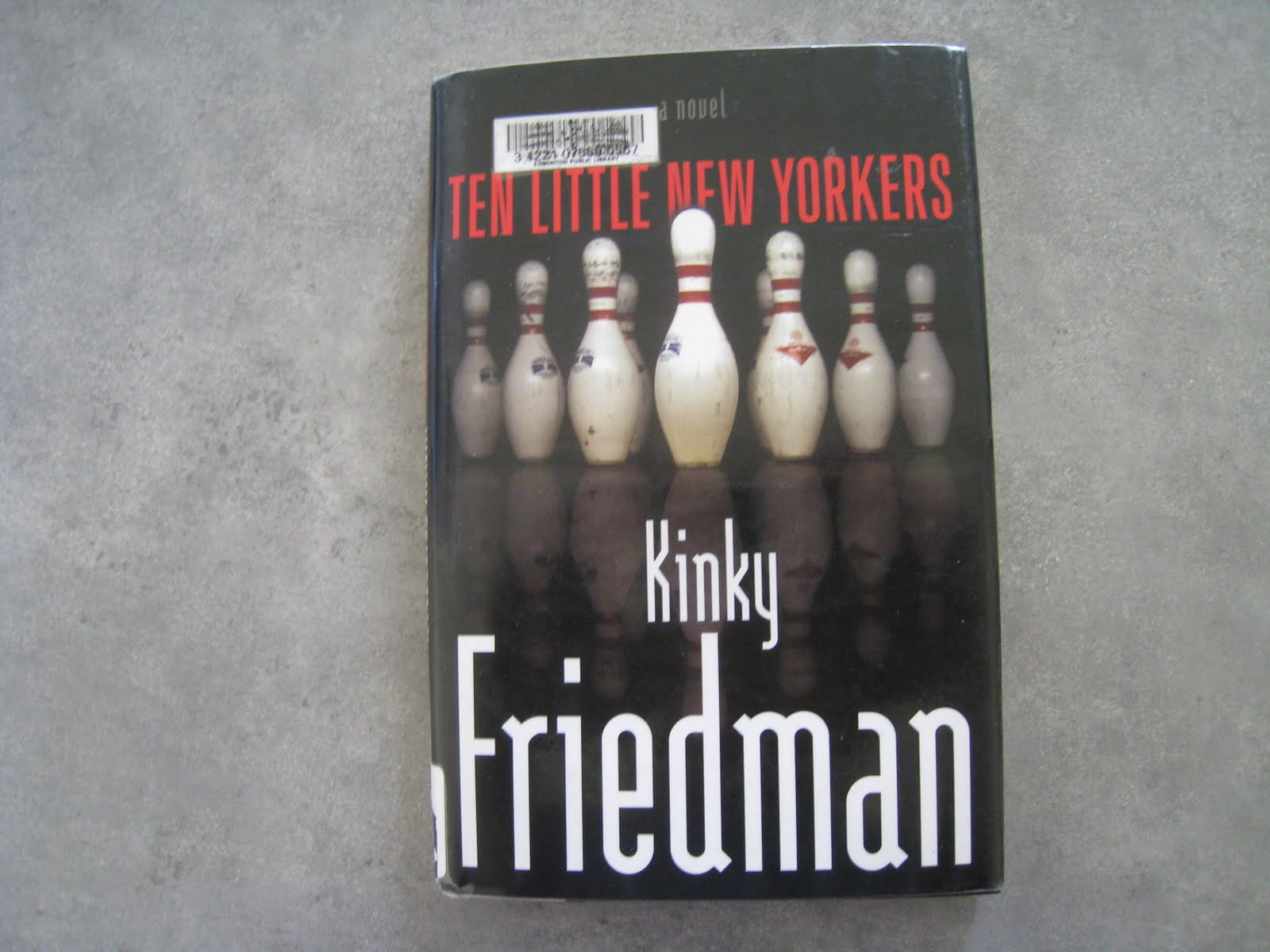
Kinky Friedman "Ten Little New Yorkers"


Well, I guess that there are eight homicides and two presumed fatalities in Ten Little New Yorkers suggests that's about it for the Kinkster, folks.

I've had a feeling that Mr Friedman was starting to run out of ideas through the last few volumes. Where once the crime side of the plot line hit the ground running, Curse of the Missing Puppet Head almost seemed to have Chinga Chavin's little difficulty with the hit and run accident thrown in to provide the Kinkster with something to do that would require a little celebration once it was accomplished, and the celebration, in turn, provided the excuse to locate the missing object.

In much the same way, the dose of malaria in Prisoner of Vandam Street provides an excuse for a gathering of the usual suspects (the Village Irregulars) and the crime, when it kicks in, serves to provide them something to spark off as they question the Kinkster's sanity and long term health prospects.

This time around, with winter chills slowing activity around Vandam Street to a near halt (even Winnie Katz's lesbian dance class has gone into hibernation and the cat has gone missing), the Kinkster lights out for the warmth of Texas.

He's not there long, though. A phone call from Mz Katz reveals the discovery of someone's wallet on the floor of a certain loft, and a subsequent call from Detective Sergeant Mort Cooperman has him winging his way back to the Big Apple to assist police with their enquiries.

The wallet found on the floor belonged, as it turns out, to a certain Robert Scalopini, who seems to have been the fourth in a series of brutal murders and the killings keep on coming, along with clues on the crime scene that seem to point towards a certain well known ex-country singer and amateur private detective or a close acquaintance with an in depth knowledge of his habits and music.

Maybe that's why the only Village Irregulars on hand are McGovern, whose articles on the killings aren't actually helping matters, and Ratso, cast in his regular and seemingly preferred role as Watson to the Kinkster's Sherlock.

While we don't get a cut and dried solution to the murders it's pretty clear that we've reached the end of the Kinkster series. It's hard to avoid the conclusion that, in the end, the stories are as much about the Irregular interaction as they are about the crimes themselves, and there are only so many ways that the regular elements - Ratso, McGovern, Rambam, the cat, the puppet head, lesbian dance classes, Big Wong's and the other landmarks around Greenwich Village - can be arranged, and Friedman has run out of possibilities.

Given the fact that Friedman has spun a reasonably limited palette out to eighteen titles that probably comes as no surprise, and while I've reached the end of the series they'll continue to provide reasonably easy and relatively lightweight reading while I'm in transit between airports and waiting around on the ground.

They're not everyone's cup of tea, but if you've tried one and liked it, they're rather moreish...

Sunday, September 4, 2011

Kinky Friedman "The Prisoner of Vandam Street"


After spending the first half of Curse of the Missing Puppethead distracted by the disappearance of the device used to deliver the key to 199B Vandam Street to visitors, Kinky Friedman goes one step further in The Prisoner of Vandam Street, confining himself to base for the whole story (on doctor's orders in the novel, but let's speculate about the authorial intention here).

Like the preceding volume it takes a while for the Kinkster to get to a case that needs solving, and this time around he sets things up so that he's not going to be the one doing the solving.

Fictional Friedman is drinking with McGovern when he collapses, the victim of a long dormant dose of malaria, involving Plasmodium falciparum, the "truly deadly" quarter of the four strains of the disease, presumably contracted while on Peace Corps duty in Borneo. It's a serious enough case to have him spending a lengthier spell than he'd have preferred in hospital (invariably spelt horespital) and when he's finally allowed to go home he's confined to barracks for at least six weeks.

It's a situation guaranteed to produce a severe case of cabin fever even if he hadn't been surrounded by supportive Greenwich Village Irregulars who, predictably, set about turning the apartment into the proverbial den of iniquity and drunken debauchery with catering by Pete Myers of Myers of Keswick.

In a rare moment of solitude amid the Irregular party action, Kinkster finds himself looking out the kitchen window through a pair of opera glasses, watching a young woman in an apartment across the street.

What starts off as a piece of harmless perving turns ugly when a man appears and brutally attacks her.

As far as the observer is concerned, he's witnessed a crime, but when he calls the cops, but they fail to find find a victim, an apartment or any other witness who has seen or heard anything suspicious.

Predictably, while the Kinkster insists there's been foul play hiss support group, Ratso, McGovern, Brennan, Myers and a VB-swilling Piers Akerman just in from Australia, are convinced it's all the result of a fevered imagination.

As a result, Village Irregular vigilance intensifies, and the Kinkster Irritability Index soars to an all-time high, while the cat embarks on a vicious turd dumping campaign targetting Ratso's back pack and similar paraphernalia.

Kinky sticks to his story and a few days later sights the man again, this time with a gun. He becomes convinced he's witnessing a cycle of domestic violence that will eventually escalate as far as murder.

Fortunately, Hollywood-based licensed private investigator Kent Perkins gives him the benefit of the doubt and arrives on the scene to look into the case. Perkins starts the investigation on the Internet before bringing his full array of resources, including hypotism, to bear as he sets about establishing whether Kinky's claims are real, identify the woman and contact her with reassurances that there is an escape route available should she wish to avail herself of it.

Along the way there are all the elements the Friedman fan has come to expect, though one suspects that Friedman the author is running out of new situations to land his fictional alter ego into, a suspicion that's got a lot to do with the Kinkster-free Kill Two Birds reviewed recently and the fact that he spends about half of Curse of the Missing Puppet Head and this story filling in a back story that has little to do with the actual investigation.

Still, as someone who's been along for the ride for close to twenty years and knows pretty much what lies in store, the prospect of eventually running out of a series long on lesbian dance troupes, grinning puppet heads, gratuitous feline defecation, an abundant supply of alcohol, Cuban cigars and yum cha isn't something I'm looking forward to...

There is (or should that be are?) however, only Ten Little New Yorkers to go.

Sunday, August 14, 2011

Kinky Friedman "Curse of the Missing Puppethead"


Curse of the Missing Puppethead didn't appear to have been too widely circulated before The Kinkster started reclaiming and rereleasing his back catalogue as ebooks under his own imprint at Vandam Press. They'll also allegedly be coming out as audiobooks in the foreseeable future.

Coming off reading Kill Two Birds & Get Stoned, it's hard not to ascribe that title's lack of the familiar Kinkster elements to an on-going lack of Kinkster inspiration, given the fact that a substantial chunk of this one involves the search for the device that gives visitors access to the fourth floor loft on Vandam Street.

If you're unfamiliar with this key element in the Kinkster oeuvre, the visitor stands on the sidewalk, hollers up a request for the key, which is lodged in the mouth of a small grinning Negro puppet head which is, in turn, attached to a parachute.

The Kinkster's literally in mid-thrust with an unnamed female associate after a party in the loft when he notices the puppet head ain't where it's supposed to be. The realisation brings with it a case of erectile dysfunction which may account for his failure to turn the loft upside down rather than setting off to investigate the disappearance by interrogating the Greenwich Village Irregulars, each of whom, in turn, pass him on to someone sighted standing near or dealing with the iconic object.

Along the way Kinky's sister calls from Hanoi, incidentally passing on the news that disappearing puppets are seen as a sign of doom in Vietnamese superstition. The curse, in this case, seems to be continued erectile dysfunction in an environment where Lexie, a gorgeous participant in Winnie Katz's lesbian dance class seems intent on exploring her alternative options. It seems that until The Kinkster finds his big puppet head, his little puppet head will continue to be missing in action.

The plot thickens a little over half way through when Kinky's college room mate Nick Chinga Chavin arrives on the doorstep, on the run from The Mob, who are out to avenge the hit-and-run murder of Big Jim Cravotta, the Butcher of Staten Island's son.

Chinga's driver Frank Holmesley has been arrested, confined on Riker's Island and word on the street suggests Chinga is destined for the high jump unless The Kinkster, with assistance from Rambam, can persuade the avenging mobster that there's an alternative explanation for the fatality.

That explanation comes too late to save the driver, but with Chinga holed up in the Vandam Street loft, drinking heavily, reading poetry and bonding with the cat, despite regular deliveries of drink, drugs and pizza, no one thinks to investigate Chavin's known associates, even after Kinky approaches Mafia boss Joe the Hyena to arrange negotiations.

That explanation duly arrives, and, fortunately checks out accurately, so during the ensuing celebrations in the Vandam Street loft once the explanation has been delivered the cat came scooting out from under the couch, chasing before her what appeared to be an extremely dirty ball of yarn. With the missing puppet head restored to its rightful location what follows later that night when Lexie and three beautiful, adventurous young friends stole their way into the place like a band of brigands was probably inevitable.

All in all, a variation on the regular Kinkster elements that's entertaining enough, but one suspects we're getting a little light on for inspiration.

Wednesday, August 3, 2011

Kinky Friedman "Kill Two Birds & Get Stoned"


News of the impending arrival of The Staggster, an avowed and admitted Kinky Friedman fan, had me doing a quick check of the online sources to check on details of recent fictional efforts by the aforesaid Mr Friedman.

As an aside, re. the current kerfuffle about the effect of online shopping on the Australian retail sector, experience suggests I'm unlikely to find what I'm looking for in a bricks and mortar establishment.

I'd gained the impression that Kinky's recent literary efforts tended towards the non-fiction sphere, heavy on personal reminiscences about political identities and musings on Texas etiquette, rather than the crime fiction based around the misadventures of the fictional Kinkster and the assorted cast of merry associates usually referred to as the Greenwich Village Irregulars.

Investigations revealed attractively-priced copies of Kill Two Birds & Get Stoned ($12.60), The Prisoner of Vandam Street ($8.86) and Ten Little New Yorkers ($9.44), so I figures those titles would round off the Friedman collection on the Little House of Concrete Bookshelves. I wasn't inclined towards What Would Kinky Do? How to Unscrew a Screwed-Up World, Kinky Friedman's Guide to Texas Etiquette: Or How to Get to Heaven or Hell Without Going Through Dallas-Fort Worth, Scuse Me While I Whip This Out: Reflections on Country Singers, Presidents and Other Troublemakers or Texas Hold 'em: How I Was Born in a Manger, Died in the Saddle and Came Back as a Horny Toad, even at a substantial discount from RRP.

I've remarked elsewhere that I thought I was going off Kinky Friedman, but there's still a place for these little potboilers in the big picture of Hughesy's reading. For a start, they're relatively lightweight in both the literary and physical sense, provide a chortle or three and make almost ideal in transit reading between The Little House of Concrete and whichever destination we're flying to.

Something to pass the time through the transit lounge, onto the aircraft, during the flight and in transit to wherever we're staying, in other words, and if you don't get all the way through a re-read this time you can always aim to finish it on the return journey or hold it over for next time.

So, yes, I've read everything up to those three titles at least once, and they'll fill a useful function once they're here and have had the rapid first squiz.

There was nothing in the advance publicity to indicate that Kill Two Birds & Get Stoned was anything other than a stock standard Kinkster adventure with all the associated hangers-on, until a glance at the blurb on the back cover revealed the identities of the main characters, novelist Walter Snow, beautiful and intelligent Clyde Potts and the certifiable Fox Harris.

Not, in other words, a Greenwich Village Irregular in sight.

And I'm not entirely sure where the Kill Two Birds bit kicks in either. There's a fairly liberal supply of Malabimbi (sic) Madness which accounts for the & Get Stoned in this tale of recovering alcoholic author Walter Snow and his newfound inspiration at the hands of a couple of leftovers from the Yippe Era of cultural terrorism.

Coming off seven years of writer's block, Walter's chance encounter with an attractive woman who needs access to a safe deposit box to secure her grandmother's Russian heirloom silverware set from the depredations of her mother's gypsy boyfriend seems relatively innocuous, but as things turn out the heirloom silverware is a dead fish, and visiting police officers advise Walter to have nothing further to do with the woman we come to know as Clyde Potts and to contact them if she contacts him.

She does re-establish contact, of course, and, equally predictably, Walter fails to contact the authorities as Clyde Potts and her associate Fox Harris inveigle the author into an escalating series of scams against corporate targets, starting with a fairly straightforward switcheroo con at an operation in the Bennigan's Irish pub-themed restaurant chain, liberating a large Afro-American inmate from a mental hospital, charging a gourmet extravaganza to Donald Trump's credit card and, finally, launching an all-out assault on a Starbucks franchise that has had the temerity to take over the premises formerly occupied by a down at heel neighbourhood Irish bar.

Along the way, Walter picks up the inspiration that gets the creative juices flowing again, though how a supposedly fictional account of these activities equates to the Great Armenian Novel isn't obvious to this reader. Predictably, by the end of the novel Walter's a best-selling author who has been able to move from his basement apartment to a large airy penthouse looking over Central Park.

Along the way things flow along at a fairly merry pace without any hint of the cornpone pholosophising we've come to know and mostly love through The Kinkster's oeuvre. There are plenty of other musings there, largely along the lines of wistful reflections of the would-be romantic recovering alcoholic, so while it's a reasonable read with its share of humour it's not quite Kinky Friedman as we've come to know the dude.

Dedicated Friedman fans are, accordingly, advised to approach with caution, while those who find the regular Kinkster offering a bit hard to take might find this alternative offering a little more palatable.

Or not, as the case might be.